.png)
Executive summary: Fixing the hidden bottleneck to growth with targeted AI and human-led intervention
For businesses that rely on qualified enquiries to drive revenue, the website is now the primary acquisition engine, yet conversion rates remain stuck at two to three per cent even as acquisition costs continue to rise.
That means 97–98% of paid and organic traffic produces no commercial value, creating a structural efficiency gap that directly impacts CAC, ROAS, and growth capacity.
This gap is widening. Competitive pressure, platform inflation and LLM-driven shifts in search mean traffic is becoming more expensive and more volatile. In this environment, improving on-site conversion is no longer optional. It is one of the highest-leverage, commercially essential ways for businesses to protect margins and meet growth targets.
The core reason conversion underperforms is that turning a visitor into an enquiry is not a single action. It requires four distinct jobs:
- Detecting intent
- Timing the intervention
- Creating trust and psychological safety
- Enabling immediate action
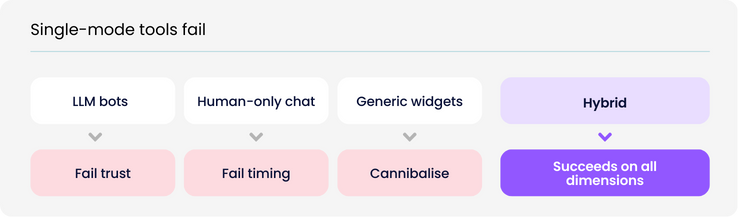
No single tool, whether a form, a bot, or traditional live chat, performs all four jobs reliably. Bots lack the behavioural ingredients for disclosure. Human-only chat lacks the precision to detect the right moment. Generic chat widgets risk cannibalising existing enquiries.
Hybrid systems solve this by combining AI and human capability so each job is handled by the component best suited to it.
- AI handles detection, timing, consistency, and accuracy.
- Humans handle reciprocity, reassurance and context - the behavioural triggers that drive disclosure.
- The system then routes high-intent visitors straight into calls, bookings, or CRM.
Across more than 150 controlled pilots, this architecture consistently delivers a 20–30% uplift in qualified enquiries from the same traffic, with a 94% trial-to-customer continuation rate. Research from MIT, Forrester, and PwC reinforces this pattern, showing that hybrid human and AI collaboration outperforms automation-only approaches wherever trust, reassurance, or disclosure influence the outcome.
The business impact is significant. Even small conversion gains can reduce effective CPL by a third, strengthen ROAS across channels and expand the scale ceiling by making each new customer cheaper to acquire. Businesses that overlook on-site conversion will be outperformed by those that optimise it.
The strategic takeaway:
In a rising-CAC environment, growth does not come from more traffic. It comes from converting more of the traffic you already have, and the most effective way to do that is with a deliberately designed hybrid human and AI system.

Introduction
High-value consumer businesses in property, travel, automotive, legal and education - all face the same issue. Traffic is getting more expensive, yet only 2-3% of visitors turn into qualified enquiries. Meaning 97-98% of paid or organic traffic leaves without engaging, despite rising CPCs and increasingly sophisticated targeting (Wordstream 2023; Forrester 2025).
This problem is becoming more acute.
As LLM-powered search changes how consumers find information, direct traffic volumes may decline, making every on-site visitor more valuable. The fastest performance lever is no longer acquiring more traffic. Converting more of the traffic you already have.
This briefing focuses on that challenge: how to turn more website visitors into qualified enquiries.
AI has advanced rapidly, analysing signals, predicting intent and responding instantly. But enquiry conversion is a behavioural sequence, not just a technical one. Timing, trust and reassurance play a decisive role, especially in high-consideration purchases.
No single tool, whether a form, bot, or a human, covers all these requirements.
The most effective systems combine AI and human strengths, assigning each to the part of the journey it is best suited for. This is not a workaround; it reflects how people make decisions online.
The commercial problem
Most marketing teams have solved the traffic problem. They can reliably drive visitors to their sites through paid search, paid social, SEO, aggregators and brand demand.
What they haven’t addressed is their conversion problem: how to turn those visitors into qualified enquiries at a rate that keeps CAC under control.
Across high-value consumer sectors, the typical website converts 2-3% of visitors into enquiries. That means 97-98% of all paid and organic sessions produce no commercial outcome.
This matters because the economics of acquisition are worsening:
- CPCs rise every year as auction pressures and platform inflation kick in.
- Incremental cost per qualified enquiry is rising even faster, meaning you pay more for each additional lead, not just the average one.
- ROAS is declining in nearly every high-intent category.
- As LLM search reshapes discovery, direct website traffic is likely to shrink, intensifying competition for every visitor that does arrive.
Put together, this creates a simple but severe commercial reality:
Revenue growth now depends less on acquiring traffic and more on recovering the value already arriving on-site.
Right now, most of that value leaks away. Marketers invest heavily in channels that drive qualified visitors, but most of those visitors leave without enquiring, even when they have clear intent.
This is the structural inefficiency:
Rising CAC → Flat conversion → Declining ROAS → Expanding pool of unrecovered value.
Before buying more traffic, businesses must address the performance gap on-site. It is one of the highest-leverage, lowest-effort parts of the funnel, yet one of the most under-optimised.
The next section explains why this gap persists and why the solution requires more than a single tool, channel or technology.
How websites capture enquiries today
Most websites rely on three mechanisms to turn visitors into enquiries: phone calls, enquiry forms, and chat.
Phone calls tend to produce high-quality conversations but depend entirely on visitors choosing to pick up the phone, which most won’t do during the early research phase.
Forms remain a dominant method for capturing enquiries and can convert a meaningful segment of traffic. But they also miss a large proportion of visitors because they require a deliberate step at a moment when many people are still comparing options. And even when forms do convert, they often perform poorly downstream: response delays, missed follow-ups, and lower intent all reduce close rates.
Live chat and chatbots exist to bridge this gap. They offer a conversational pathway that can surface intent earlier, reduce friction, answer context-specific questions, and move a visitor into an enquiry before they disappear.
However, most ‘chat' solutions merely move leads from one channel to another, rather than materially increasing volume and quality.
Whether chat genuinely succeeds depends entirely on the capabilities behind it - detection, timing, trust-building, and seamless routing.
Most chat deployments fail because they treat chat as a single interaction rather than a sequence of behavioural jobs that must be executed in the right order to create disclosure.
This is the core reason enquiry generation stalls:
chat works only when the underlying system performs all four jobs required for a visitor to convert.
The real reason conversion stalls: It’s four jobs, not one
Website chat was originally introduced as another route for visitors to register interest, a theoretically lower-friction alternative to forms. But early chat and bot solutions never improved enquiry rates in any meaningful way because they focused on the interaction, not the full conversion process.
Converting a visitor into a qualified enquiry is not a single action. It’s four separate jobs that need to happen in the right sequence. If any one of them fails, the conversion is lost, or worse, you cannibalise enquiries you would have received anyway.
The four jobs of on-site conversion
1. Detecting opportunity
Recognising behaviour that signals intent or hesitation, such as scroll depth, repeat visits and form abandonment. If this signal is wrong, chat fires at the wrong moments and cannibalises existing enquiries instead of creating incremental ones.
2. Timing the intervention
Engaging before the visitor leaves, not after. Intent peaks and disappears in seconds. Generic chat widgets trigger too early or too late, missing the window entirely.
3. Creating trust & psychological safety
People only disclose details when they feel understood and safe. This is where bots fall short. Even when conversationally fluent, they don’t trigger reciprocity, the behavioural mechanism behind disclosure.
Research shows visitors are 4-5 times more likely to share contact information with a human than with an automated system, even when the conversation is indistinguishable (MIT Sloan 2024; Forrester 2024).
4. Enabling action
Making it effortless to move from interest to enquiry, whether by submitting details, booking, or connecting instantly. If this step is slow or disconnected from downstream systems, the opportunity disappears.
Why single-mode solutions fail
Most chat tools, whether human-only, bot-only, or generic live chat, fail for predictable reasons:
- They lack intelligent targeting, so they trigger too broadly and cannibalise traffic rather than lifting conversion
- They miss the moment, engaging after intent has passed
- Bots fail at trust formation, leading to far lower disclosure rates than human-led conversations
- Human-only chat lacks the AI-driven precision needed to detect and prioritise high-value moments
The result is that they only capture visitors who were already ready to enquire, meaning no incremental value.
No single tool can deliver all four conversion jobs. And without all four, you cannot reliably create incremental enquiries.
This is why conversion requires a system, not a widget and why hybrid human-AI design consistently outperforms isolated approaches.
The hybrid solution

Once the four jobs of on-site conversion are understood, the architecture required to perform them becomes clear. A complete system needs to:
- Detect high-value intent
- Intervene at the right moment
- Create the conditions for disclosure
- Seamlessly route the outcome into pipeline
No single component can perform all four jobs. Hybrid systems combine AI and human capability, so each job is handled by the component best suited to it.
How the hybrid conversion system works
Controlled pilots across lead-generation verticals such as property, travel, finance, and automotive- consistently show that this architecture delivers a 20-30% uplift in qualified enquiries from existing traffic, outperforming AI-only, bot-only and human-only models.
Evidence from the field
SmartChat trials are not run indiscriminately. A pilot is offered only when a detailed review of the website, traffic mix and commercial objectives indicates a high probability of success. This discipline ensures that trials measure true incremental lift rather than noise.
Across more than 150 live pilots run in 2024 to 2025, 94% of businesses chose to continue with SmartChat after the evaluation period. This conversion rate reflects both the selective trial approach and the consistency of performance in high-value lead-generation environments.
Below are examples of observed outcomes from publicly available case studies across sectors such as property, travel, finance and automotive:
Notably, many of these businesses had previously used live chat in various forms, including pure AI chatbots and traditional human-led chat, but only meaningful uplift when the hybrid SmartChat system was introduced.
Hybrid performance follows a clear pattern: precise targeting + AI-assisted knowledge + human reassurance + instant routing consistently produce material uplifts in qualified enquiries from the same traffic.
Across controlled pilots and live deployments, SmartChat typically delivers a 20–30% increase in qualified enquiries without additional media spend.
Independent validation
The performance pattern seen in SmartChat trials aligns closely with independent research across AI, behavioural psychology and customer experience. Across multiple studies, the same conclusion emerges: hybrid human and AI systems outperform automation-only approaches when persuasion, trust, or disclosure influence the outcome.
AI & human collaboration
- MIT Center for Collective Intelligence
Hybrid models outperform single-mode systems when each component handles the tasks suited to its strengths - AI for pattern detection and consistency; humans for persuasion, judgement, and context.
Source: “Humans and AI: Do They Work Better Together or Alone?” - MIT Sloan – When Humans and AI Work Best Together
Collaboration succeeds when AI manages data-driven tasks and humans provide the social and contextual intelligence that shapes decisions.
Consumer trust & behaviour
- Forrester (2024)
Only 16% of consumers regularly use chatbots; one-third avoid them entirely - an explicit signal of trust and comfort preferences in digital interactions. - PwC – Future of Customer Experience
Brands delivering human-assisted digital interactions achieve up to 10× higher satisfaction scores and can command price premiums of up to 16%, indicating the commercial value of perceived human presence.
Speed, trust & disclosure
- InsideSales / CallDrip
Responding to a lead within five minutes increases conversion odds by up to 100× compared to a 30-minute delay. The “moment of intent” is brief - systems that identify high-intent behaviour and immediately connect humans outperform delayed or automated follow-up.
Behavioural psychology & reciprocity
Independent behavioural research consistently shows that people are 4-5× more likely to disclose personal information to a human than to an automated system, even when the automated exchange appears human. This aligns with well-established reciprocity effects in high-consideration decisions, where human cues increase emotional safety and strengthen commitment.
The business impact
For most high-value consumer businesses, the website is not a channel. It’s the engine of revenue. Property, travel, automotive, legal and education all depend on turning website visitors into qualified enquiries at a cost that keeps CAC sustainable.
That engine is now under pressure. Acquisition gets more expensive every year, CPCs rise, ROAS declines and traffic becomes harder to secure. In this environment, improving on-site conversion is not a marginal optimisation. strategic and existential. Businesses that don’t improve it will simply be out-competed by those that do.
Conversion as the highest-leverage growth lever
Small increases in visitor-to-enquiry conversion produce outsized financial gains. A move from two to three percent conversion is a 50% efficiency uplift, cutting effective cost-per-lead by a third without increasing spend.
Recovering value from existing traffic
Hybrid human and AI systems typically deliver a 20 to 30% uplift in qualified enquiries from the same traffic. That recovered value compounds across paid search, social, SEO, direct, referral and aggregator channels, making every marketing dollar work harder.
Lower CAC, higher ROAS, greater scale
When more of your existing traffic converts, blended CAC drops and channel ROI improves. This doesn’t just protect margins; it expands the scale ceiling. Businesses with stronger on-site conversion can profitably acquire more customers than competitors at the same media price.
Capturing intent while it’s live
Instant routing into calls or bookings captures high-intent visitors in seconds. Independent studies show that responding within five minutes increases conversion odds by up to 100 times compared with traditional follow-up cycles. This materially improves downstream close rates, not just lead volume.
Strategic takeaway
In a rising-CAC environment, growth goes to the businesses that convert better, not the ones that spend more. Improving on-site conversion lowers acquisition costs, strengthens unit economics and increases the scale at which a business can grow. Hybrid human and AI systems recover the value traditional tools miss - and in a rising CAC environment, that gap defines who grows and who doesn’t.
.png)
.png)
.png)